Custom Furniture for Apartments: Quieting Your Built-ins

Custom Furniture can be made quiet from the start — most built-in noise is not the drawers, it is the gaps, the hard backs, and the cheap hinges that let panels ring. Build it right and your HDB flat stays peaceful at night.
Where the noise actually comes from
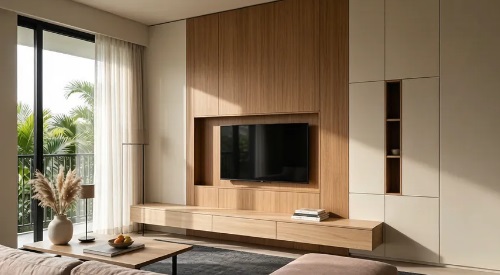
A wardrobe in a 4-room HDB flat (about 90 sqm) sits close to the bed, so every click travels. The usual culprits are a hollow cabinet back that acts like a drum, doors that slam because the hinges are basic, and a 20mm gap at the top where the panel vibrates against the wall. None of these are the furniture's fault by design — they are the cheap version of it.
Condos are worse for neighbour sound because the party wall is thin. A rattling built-in against that wall keeps both you and the next unit awake. The fix is in the build, not in taping it later.
Custom Furniture details that kill the rattle
We spec quiet parts from the first drawing. The list is short and it works:
- Soft-close hinges and runners on every door and drawer — they cost a little more and remove 90% of the noise in one move.
- A filled back panel, 9mm plywood, glued not just pinned — a pinned 3mm board rings; a glued 9mm one stays dead.
- Foam strip where the unit meets the wall — closes the gap that hums when the air-con kicks in.
- Felt pads on internal shelves — folded stacks stop sliding and tapping when you open a door.
Material matters too. Solid wood is dense and naturally quiet but pricey and prone to move with humidity. Plywood with laminate is the plain choice — stable, calm, and kind to the budget. MDF is the quietest raw board but it hates moisture, so keep it away from the bathroom wall.
How we test before we install
On the workshop bench we shut each door and pull each drawer. If a front rings, we add a rubber bumper or tighten the hinge cup. We also check the unit does not rock — a wobble on a hard floor is a low hum you will feel through the wall at 2am.
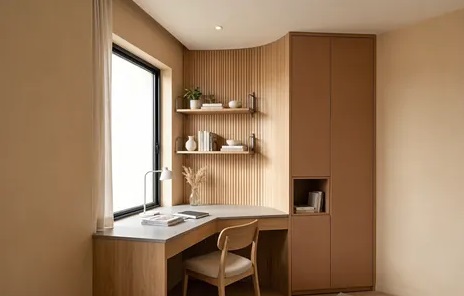
For a study built-in against a condo party wall, we leave a 12mm air gap and line it with a thin acoustic foam. That gap breaks the path the sound would take straight into the neighbour's bedroom. It is a small detail that saves a friendship.
Cost, timeline, and HDB rules
Quieting a built-in adds roughly S$400 to S$1,200 to a room's cabinetry — mostly better hinges and the foam work. That is a small part of the S$30k to S$70k most renovations run. HDB has no rule against a quiet wardrobe; just do not build into the bomb shelter wall or block the window, and keep to the 1-year defect liability window if something later loosens.
Timeline holds at the standard 6 to 10 weeks from measure to install. The quiet parts ship with the rest, so there is no extra visit. Soft-close hardware is fitted at the workshop, not retrofitted.
Keeping it quiet over the years
Hinges drift. Once a year, give each a half-turn with the small screw and the soft-close returns. Wipe the felt pads — dust makes them slip. If a door starts to tap, it is almost always a loose screw, not a broken part.
A home should be calm, and your storage should not be the thing that wakes you. Whole-house customization lets us build the silence in from day one, shaped to your wall and your sleep. Ask for soft-close and a filled back and you will notice the difference every night.