Singapore HDB Kitchen Carpenter: Plywood or Particleboard?

A Singapore HDB kitchen carpenter faces one decision that shapes the next decade more than any other: what sits inside the cabinet box. The choice is usually between plywood and particleboard, and the difference shows up the first time a pipe drips or the weather turns. Both are marketed as "wood", but they behave nothing alike in a Singapore kitchen, and the price gap between them is smaller than most people fear.
What each board actually is
Plywood is thin layers of real wood veneer glued at crossed angles. It bends a little under load but it does not crumble, and when water reaches the edge it swells slowly and can dry. Particleboard, also called chipboard, is wood dust and resin pressed into a sheet. It is flat, cheap, and uniform, which carpenters like for clean cuts. The problem is the core: once moisture gets past the edge banding, particleboard soaks it up like a sponge and stays swollen.
In Singapore's climate, where the kitchen sees daily steam and the occasional overflow, that matters. A particleboard base near the sink can start to puff at the kickboard within five to eight years. Plywood in the same spot keeps its shape past fifteen.
The cost gap in real quotes
For a standard HDB kitchen, particleboard with laminate doors runs S$3,000 to S$6,000. Plywood with E0 board and the same doors runs S$4,800 to S$7,200 for a 20 to 30 foot run. The spread is roughly S$1,800 to S$1,500 across the whole kitchen, or about the price of a good hood. Spread over ten years of use, plywood costs less per year even at the higher ticket.
E0 is the emission grade, not the board type. You can get E0 particleboard and E0 plywood. The grade tells you about formaldehyde release and indoor air, the board type tells you about water. For a kitchen, pick E0 and plywood together if the budget stretches. If you must choose one, take plywood at a lower emission grade over particleboard at E0, because a swollen box fails faster than a low-emission one ages.
Where each board earns its keep
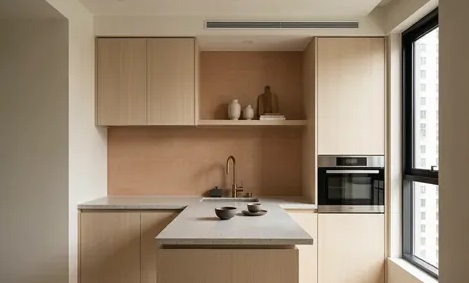
Use plywood for anything below the counter and anything near water: base cabinets, the sink cabinet, the tall unit beside the fridge. Particleboard is acceptable for top cabinets that stay dry and for wardrobes in the bedroom where steam never reaches. A mixed spec, plywood below and particleboard up high, is a fair compromise that trims cost without risking the wet zones.
Ask the carpenter to write the board on the quote by grade and thickness. A 12mm or 15mm plywood carcass is the floor for a kitchen base. Anything thinner flexes when you load the drawers, and no amount of nice doors hides a wobbling box.
Mixing the two to stretch the budget
A mixed spec is the quiet way to save without taking on risk. Use plywood for every base cabinet and the tall unit where steam and weight live, then allow particleboard for the top row that stays dry and light. The saving lands in the S$1,500 to S$1,800 range across the kitchen, and you keep the wet zones safe. Tell the carpenter to write both boards on the quote so you can see exactly where the cheaper sheet sits and confirm it never ends up near the sink. A kitchen planned this way costs less and still survives the humidity, which is the whole point of the exercise.
The board you never see decides whether your kitchen looks new at year ten or year five. Pay for the inside, and the outside takes care of itself.