Custom Furniture for Dining: A Table for Eight That Stows
Custom Furniture lets a 5-room flat host eight for reunion dinner and then shrink back to a two-top by Tuesday, because a stowable table built to your wall and your habits beats a fixed slab you keep bumping into. In roughly 110 square metres, that flexibility is the difference between a dining corner you love and one you avoid.
Choose the stow style that fits your flat
Not every extending table suits a local home. Pick by the space you have and how often you really seat eight.
- Wall-mounted drop-leaf — folds flat to the wall, pulls down for guests. Best for a 4-room where the dining corner is tight.
- Butterfly leaf — the extra panel stores inside the table, so nothing gets lost under the bed.
- Extending runner — a centre section slides out and two leaves clip in; seats six to eight with ease.
- Pull-out from a sideboard — the table top hides in the console and lifts out when needed. Clever, but heavier to operate.
Size it for the room, not the brochure
Eight seats sounds grand until the chairs will not pull out. We plan the footprint before the wood.
- Seated width — allow 600mm per person, so eight needs about 2.4 metres of table edge.
- Pull-out room — each chair needs 450mm behind it; check the wall behind before you commit.
- Stowed depth — a drop-leaf against the wall should sit under 350mm deep so the walkway stays clear.
- Height — keep it at 750mm to match standard dining chairs you already own.
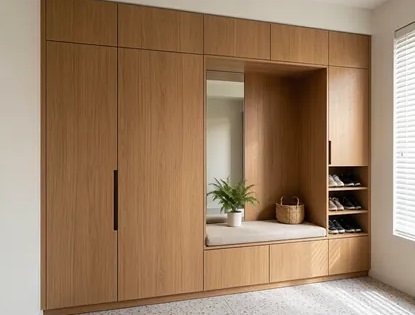
If the room will not take eight with chairs out, we build for six comfy and eight tight, and tell you honestly which it is.
Custom Furniture with the storage built in
A stowable table should not create a new problem of where the leaves go. We design the storage into the same piece.
Leaf bay in the sideboard — the console beneath the wall-mounted top holds the folded panels and the spare chairs' cushions.
Floor slot on castors — the leaf slides under the fixed table section on a tray, so one person can manage it.
Hinged apron — a false drawer front drops to support the leaf, removing the need for a separate leg when guests arrive.
Materials that take our climate and our festivals
A dining table sees wet cups, hot pots and the occasional spilled lor mai kai, so the top has to cope.
- Solid teak or oak — warm and hard-wearing; oil it yearly and it ages well through the humidity.
- Plywood core with laminate — steady, won't warp, and a wood-look face reads close to solid timber.
- Veneered MDF top — smooth and cheap, but use a mat under hot pots or the surface marks.
- Metal base, wood top — a powder-coated leg frame stays put on our tiles and will not rust.
Rules, budget and the build window
A dining table is loose or semi-fixed furniture, so HDB has no say in it beyond not blocking the escape route or window. Condo MCSTs seldom care about an internal table, though a wall-mounted drop-leaf still needs solid fixing into your own wall.
Expect roughly S$1,500 to S$4,000 for a custom eight-seat stowable table with its storage, finished to match the rest of the home. It builds in the same 6-to-10-week window as the kitchen and wardrobes, so the whole house arrives together.
Most families keep it inside the S$30k-70k renovation budget by trading a few loose pieces for one that does the job of two.
A table that grows for the family and shrinks for the weekday gives a small flat room to breathe all year. Picture your next gathering, then picture Tuesday night, and build for both.