Custom Furniture Quality: Spotting Work That Won't Fail
For Custom Furniture, you can spot work that won't fail before you pay, using your eyes, a finger, and a few straight questions. Tight seams, square frames, named hardware, and a written warranty are the signs. Loose edges, staples on show, and vague quotes are the warnings. Learn the checklist and you'll choose with confidence.
Look at the seams and corners
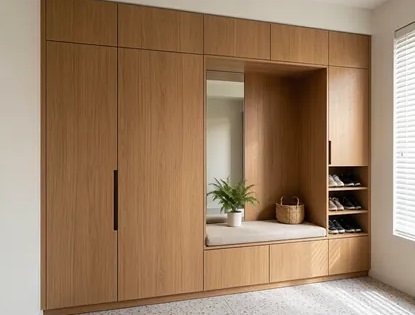
The fastest read is the joint. Run a finger along any meeting edge; a good piece feels flush, with no step or ridge. Look at the corners of a door — the grain or colour should meet cleanly, not stop short or overlap. In a 4-room HDB of roughly 90 sqm, carpentry runs long distances, so a small gap at the bench becomes a bright light line across your wall.
Check that doors sit evenly spaced from each other and the carcass. If one gap is wider, the frame wasn't squared or the hinge wasn't adjusted. Both are fixable early, costly later.
Test the movement
Open everything. A quality drawer on full-extension runners pulls all the way out and stays level. A door on a soft-close hinge eases shut without a slam. Push the top corner of a tall unit; it should barely move. If it rocks, the back panel isn't seated in a groove and the piece will rack over time.
- Open each drawer and lift slightly — it shouldn't tilt or drop.
- Close doors and listen — a soft close is quiet, a cheap one bangs.
- Press the centre of a shelf — it shouldn't bow or creak.
Read the materials honestly

Ask what's inside. Quality work states the board grade and thickness — 18mm plywood for base carcasses, 12mm for shelves is a fair spec. Edge banding should be a proper PVC or acrylic strip, glued and trimmed, not a thin tape peeling at the corner. On a 5-room HDB around 110 sqm, the volume of carpentry means these details repeat hundreds of times; consistent quality is what you're really buying.
- Plywood core over MDF near wet zones resists our humidity better.
- Concealed fixings beat staples and visible screws.
- Adjustable hinges let gaps be tuned after fitting.
Custom Furniture quality in the paperwork
The build is only as good as the promise behind it. A serious workshop puts specifics in writing:
- Named hardware and board, not "standard soft close."
- A defect period on workmanship, commonly 12 months.
- What's covered — dropping doors, jammed drawers, peeling edges.

Remember the HDB one-year defect liability period covers the flat's own structure from the builder, not carpentry you commissioned. Your protection is the workshop's warranty, so read it and keep it. Condo MCST rules add their own approval steps for works, but they don't grade your carpenter's skill — that's still on you to check.
Red flags to walk away from
A few signs tell you to pause before paying the deposit:
- The quote lists no material names, just "carpentry."
- The workshop won't show a finished job or a half-built carcass.
- They measure from photos instead of your actual walls.
- The timeline sounds too fast — under 6 weeks for a whole home often means rushed glue-ups.
Prices for whole-house carpentry sit inside the broader S$30k to S$70k renovation range, and the cheapest quote usually hides the thinnest board or the unnamed hinge. Spending a little more on verified quality costs less than redoing a failed wardrobe in year two.
Quality in furniture is mostly invisible until it fails, which is exactly why you have to check it before it's installed. The seams, the movement, the named parts, and the written promise together tell you whether a piece will still feel right when the flat is no longer new. If you're choosing a workshop, take ten minutes to apply this list at their site — the answers you get will tell you more than any glossy render, and save you from the slow regret of work that quietly comes apart.