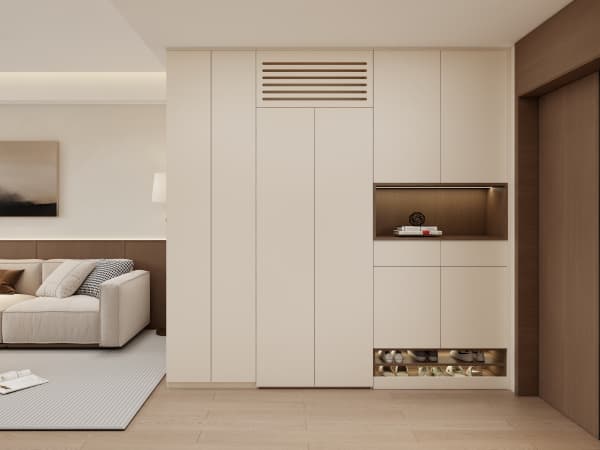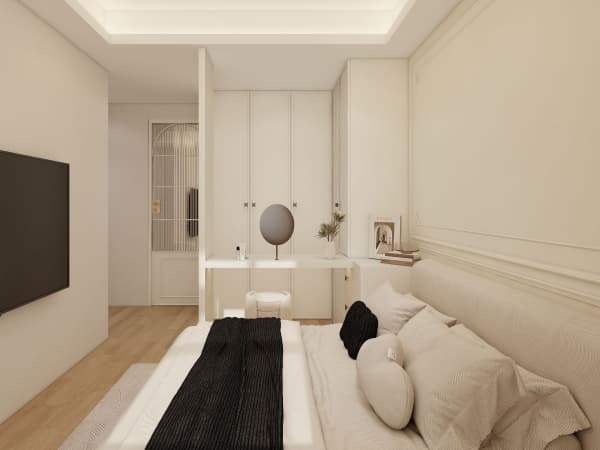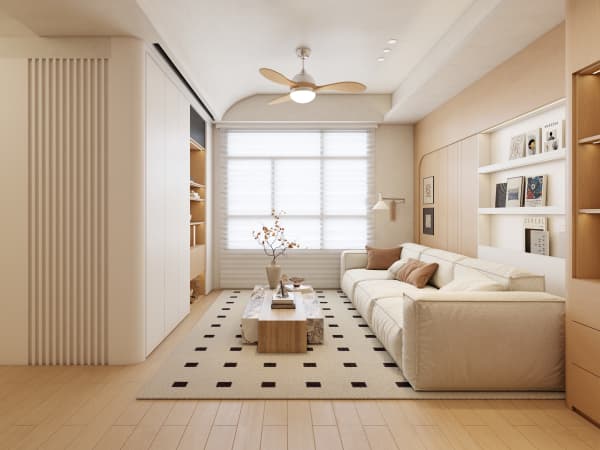
Custom Furniture Build: How the Workshop Makes It
For Custom Furniture, the build happens off-site in a workshop, not in your home. Your space gets measured, the pieces are cut and assembled in the factory, then delivered and fixed in a day or two. Knowing the steps helps you spot a shop that's organised and one that's guessing.
Step one: the measure
It starts after your walls are up and plastered. A good workshop measures twice, at the site, with a laser, not from a floor plan. HDB walls aren't perfectly square, and a 4-room flat of roughly 90 sqm can be off by 10mm corner to corner. That gap is the reason a cabinet built from the plan alone leaves a filler strip you didn't want.
Expect the measure to take an hour for a full home. If someone quotes you from photos, that's a red flag for a job this size.
Step two: design and confirmation
You get a 3D layout and a quote that names materials, hardware, and finish. Read it like a contract, because it is one. Confirm:
- Board grade and thickness for each zone.
- Hardware brand and soft-close spec.
- Edge profile and any rounded corners.
- Internal fittings — shelves, dividers, lighting, drawers.
This is also when the timeline is set. A whole-house job from measure to install runs roughly 6 to 10 weeks, with most of that in the workshop, not on your site.
Step three: cutting and assembly
In the workshop, boards are cut on a panel saw for straight lines and drilled on a CNC or template so every hole lands where the hinges expect it. Edges get banded, doors get their profiles, and carcasses are dry-assembled to check square before they're flat-packed for delivery.
- Panels are cut and edge-banded in batches to keep grain and colour matched.
- Holes are pre-drilled so on-site fitting is just alignment, not power tools.
- A sample door is often made first so you can sign off the finish.
Condo MCST rules usually limit noisy cutting on-site, which is another reason the real work happens in the factory. You'll just see a tidy install, not a weekend of sawing.
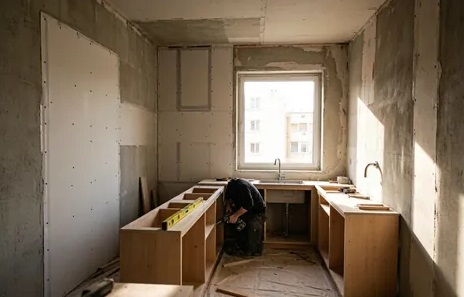
Step four: delivery and install
The crew brings flat-packed panels, assembles them against your walls, levels with shims, and fixes tall units to the wall for safety. A full home might take two to four days depending on scope. Good teams protect your floors and clean as they go.
After fitting, the one-year HDB defect liability period on the building doesn't apply to this carpentry. The workshop's own defect period — often 12 months on workmanship — is what covers a door that drops or a drawer that jams. Get it written down.
Custom Furniture build: questions to ask
Use these to judge a workshop before you commit:
- Where is it built? A real workshop beats a guy with a saw in a lorry.
- Who installs? Their own crew, not outsourced day labour, means accountability.
- What's the rework process? Clear answer now saves arguments later.
Understanding the build takes the mystery out of the wait. Most of the craft happens where you'll never stand, and the install is just the visible end of weeks of careful cutting. If you're about to start a whole-house project, asking a workshop to walk you through these four steps tells you quickly whether they run a tight ship or hope for the best — and that answer is worth more than any discount they offer.