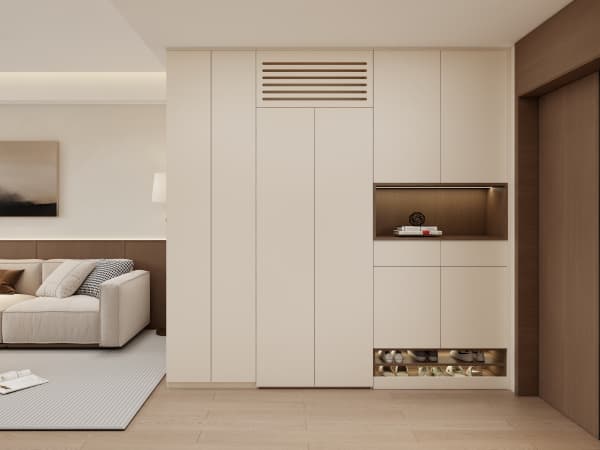
Custom Furniture Cost: What Drives the Final Number
The final Custom Furniture cost is driven by three things above all: the board you choose, the number of metres built, and the hardware grade, with layout complexity adding the rest on top.
The board is the biggest driver
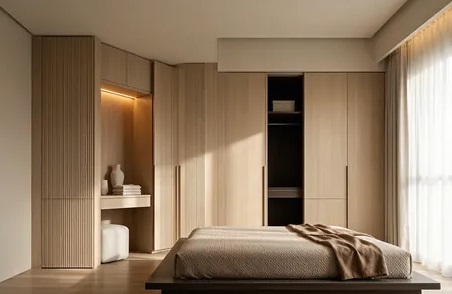
Material sets the floor for the whole price. The same wardrobe in different carcasses can vary by a wide margin.
Laminate on particle board – the lean choice, fine for dry, low-wear spots.
Laminate on plywood – the common middle, stable and screw-friendly.
Veneer or lacquer finish – real wood face or sprayed look, more costly.
Solid wood – the top tier, with care needs and a price to match.
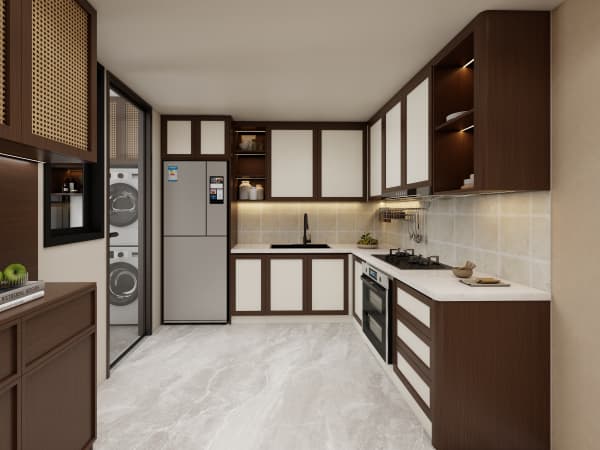
Thickness matters too. An 18mm carcass costs more than 16mm but holds heavier loads better, which matters for a 5-room HDB kitchen at roughly 110 sqm where the cabinets carry real weight.
Metres and modules add up fast
Furniture is mostly priced per metre of carcass and per door or drawer face. A long run quietly becomes a big number.
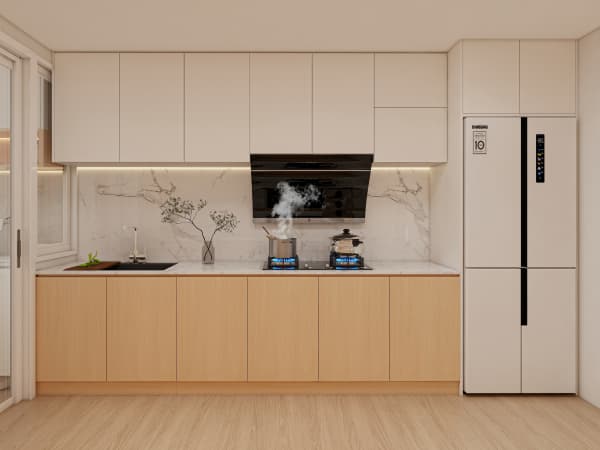
Linear metres – a 4-metre kitchen costs about twice a 2-metre one, not counting extras.
Number of doors – each door is cut, edged, hinged, and handled.
Drawers – far pricier than shelves because of runners and boxes.
Internal fittings – trays, dividers, and pull-outs each add a line item.
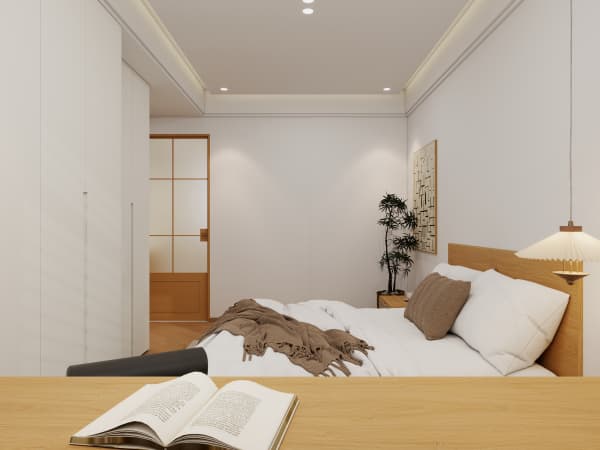
A 4-room flat near 90 sqm with a modest kitchen and two wardrobes stays lighter than a 5-room with a feature wall, study, and full-height storage. Scope is the second engine of cost.
Custom Furniture cost and hardware choices
This is where two near-identical quotes diverge. Hardware is quoted per piece, but a home has hundreds of pieces.
Basic hinges – cheap now, noisy later, and they don't self-close.
Branded soft-close – the local standard for a reason; smooth and lasting.
Top-tier systems – lovely motion, but the premium is felt more than seen.
Drawer runners follow the same ladder. Full-extension soft-close costs more than a basic slide, yet it's the single fitting you'll appreciate most in the kitchen and wardrobe.
Complexity, curves, and glass
Straight boxes are cheap to make. Everything else adds machine time and skill.
Curves and angled ends – need templating and special cuts.
Glass doors and inserts – pricier material and careful handling.
Integrated lighting – adds wiring, drivers, and a power source.
Ceiling-following tops – where the slab is uneven, scribing takes labour.
None of these are wrong; they're just costs to name before you commit. A plain, straight design can look clean and save a chunk versus a heavily detailed one.
Putting a number on your own home
Start with a per-metre estimate for your chosen board, then multiply by your planned metres, then add hardware and any fancy bits.
For most Singapore homes, the furniture portion lands roughly between S$15,000 and S$45,000, sitting inside the broader S$30,000 to S$70,000 renovation budget. HDB guidelines and condo MCST rules don't change the furniture price much, but they shape the timeline and the install logistics.
The honest way to control cost is to decide, room by room, where board grade, hardware, and detail truly matter. When you drive those three levers on purpose, the final number becomes something you set rather than something that lands on you.