Custom Furniture for headboard: A Crate Stack That Rolls
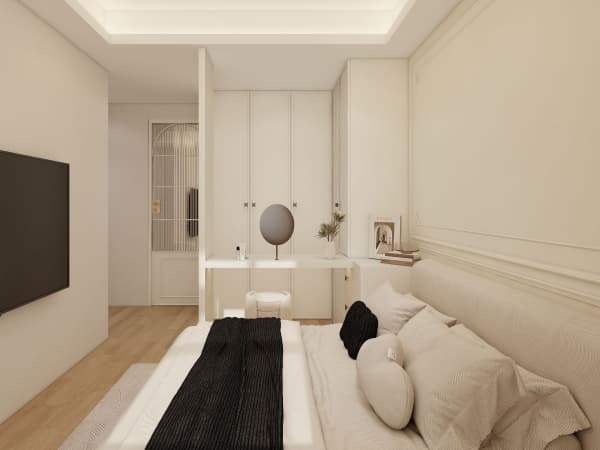
Custom Furniture turns the dead wall behind your bed into a rolling crate stack you can pull out at night, and it's one of the neatest small-bedroom tricks I show BTO owners. Build open cubes on hidden castors behind a flush front, and bedside storage finally moves with you.
A typical HDB bedroom in a 4-room flat runs about 3m by 3.3m, so every centimetre counts. A rolling crate headboard keeps books, chargers, and the kids' toys within arm's reach, then lets you wheel a crate out to sort it properly.
Why a Rolling Crate Headboard Works in a Small Room
The gap between your mattress and the wall is usually wasted. A fixed headboard just sits there. Swap it for a frame of open crates and you gain three things a plain panel never offers:
- Easy access — pull any crate forward on its castors instead of digging behind the bed.
- Visual lightness — open cubes read lighter than a solid cabinet, so the room feels bigger.
- Flexible sorting — one crate for medicine, one for chargers, one for the toddler's board books.

Because the crates roll, you can deep-clean behind the bed in seconds. In Singapore's humidity that matters more than most people expect.
Plan the Crate Layout Before You Build
Measure the bed first, then the wall. A queen bed is 1.5m wide; leave at least 300mm of crate on each side so neither block sits under a pillow. Sketch the crate heights to match your mattress top.
- Low crates at the base — easiest for kids to reach, good for shoes and library books.
- Mid crates at pillow height — perfect for the phone, the eye mask, and the current novel.
- Top crates near the ceiling — seasonal stuff you rarely touch, pulled down only at spring clean.
Keep the whole stack no taller than the mattress top plus 300mm. Go higher and you'll bonk your head reading at night.
Custom Furniture Materials for the Crates
Pick your board the way you would for any bedroom cabinet:
- Plywood carcass — stable and resists warping in our weather; my default for anything that moves.
- Laminate-faced MDF — smooth and cheap for crate faces, but seal the edges so moisture stays out.
- Solid timber — lovely for one feature crate, though it costs more and needs the odd oiling.
I steer most families to plywood crates with a laminate wrap. It survives knocks from the kids and wipes clean after a spilled Milo.
Castors, Safety, and the Wall Behind
Rolling furniture in a bedroom has a few non-negotiables:
- Locking castors — fit brakes on at least two wheels so a crate can't drift while the bed is made.
- Soft-tread wheels — they roll quietly on tile and won't chew the vinyl flooring.
- Wall anchor the frame — a tall headboard frame should be fixed to the wall stud for safety.
- Clear floor lane — leave roughly 400mm for a crate to pull out without hitting the door.
Check the castor bolts every six months. A loose wheel is the fastest way to scratch a floor you just paid to lay.
Cost, Timeline, and Daily Care
This is a small job. Expect to pay on average a few hundred dollars for a two- to three-crate run, more if you add LED strips or a laminate back panel. The full measure-to-install cycle is roughly 6 to 10 weeks once the layout is fixed.
Wipe the castors monthly so grit doesn't jam the bearings. Treat it gently and the crates will outlast the mattress you built them around.
If your bedroom feels cramped and the wall behind the bed is doing nothing, a rolling crate headboard is worth a serious look. It's a small, sensible piece of whole-house customization that earns its keep every single night — and those quiet wins are exactly what a well-planned home is built on.