Custom Furniture in common room: A Edge That Won't Chip
Custom Furniture in your common room should survive daily knocks, not just look good on day one. The trick is in the edge — a properly banded, solid edge that won't chip when a chair bumps it or a vacuum catches the corner. Here's how we spec it so it lasts.
Why the Edge Is the First Thing to Fail
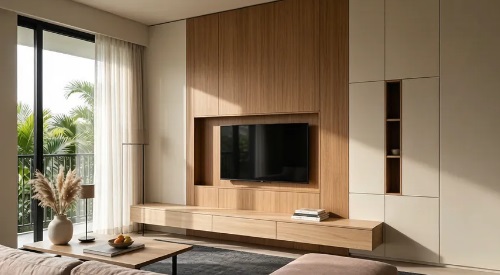
Most common rooms in Singapore pull double duty. It's a study by day, a guest room on weekends, and a storeroom the rest of the time. Doors open and close a lot, and edges take the hits. A thin or poorly glued edge band starts lifting within a year.
The usual culprit is exposed particle board edges or cheap PVC tape that was never pressed properly. Once moisture gets in, the board swells and the chip spreads. You can't sand that out, and you can't repaint over a lifted edge.
Custom Furniture Materials That Hold Up
For a common room we usually recommend one of these three build types:
- Plywood with ABS edge band — 12mm or 18mm birch or hardwood plywood, finished with a thick 2mm ABS band. This is our default for shelves and study tables because the band absorbs impact instead of cracking.
- Solid wood edge strips — a real timber lip glued and clamped to the board. It can be sanded and refinished if it ever dents, which makes it the most repairable option.
- Full-board laminate wrap — where the laminate is folded over the edge so there is no separate band to lift. Good for wardrobe carcasses and fixed cabinets.
MDF is fine for painted built-ins that won't be bumped, but it chips badly at the edge if a board is left exposed. We avoid leaving MDF edges raw in a common room.
Edge Banding Options, Plain and Simple
The band itself matters as much as the board. Here's the short version:
- 0.4mm to 1mm PVC — cheap, looks tidy, but cracks on hard impact. Fine for low-traffic spots.
- 2mm ABS — tougher, slightly rounded, the sweet spot for study desks and open shelves.
- Solid timber lip — best for a feature edge you can feel, and the only one you can sand back.
Ask the workshop how the band is applied. Hot-air or laser welded ABS holds far better than contact-glued tape, and it won't peel in Singapore's humidity. That detail alone decides whether your edge lasts two years or ten.

Practical Steps We Follow on Site
When you plan Custom Furniture for a small common room, here's the order we work in:
- Measure twice against the HDB floor plan, then check the actual wall — common room walls are rarely square, and a 10mm lean throws off every edge.
- Decide the traffic path first. If a chair or trolley passes a shelf corner daily, that corner gets a full timber lip, not a thin band.
- Specify the band thickness in writing on the quote, so the workshop can't quietly swap to 0.4mm to save cost.
- Seal the bottom 50mm of any unit that sits on the floor, since mopping splash is the silent killer of edge bands.
Cost and Timeline You Can Expect
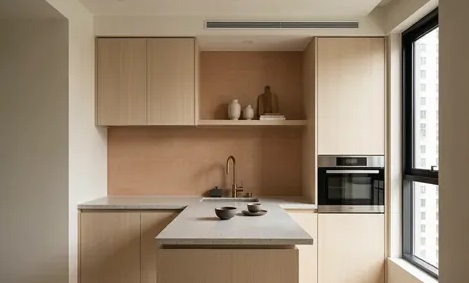
A common room built-in — say a study nook with a wardrobe and overhead loft — runs roughly S$4,000 to S$9,000 depending on materials and how much is full-height. The full journey from measure to install is usually 6 to 10 weeks: about a week to measure and design, two to three weeks for HDB submission if walls move, and four to six weeks for the workshop to build and deliver.
Remember the HDB renovation rules: you can't hack structural walls, and fixed cabinets must keep the required clearances. The good news is that a 1-year defect liability period applies to registered contractors, so a lifted edge within twelve months should be fixed at no charge.
Keeping the Edge Looking New
Maintenance is light if you set it up right. Wipe edges with a damp cloth, never a soaking wet one. Avoid leaning a wet mop against the base of cabinets. If you see a band starting to lift at a corner, call it in early — a small reglue now beats a full replacement later.
For condo owners, check your MCST rules before fixing anything to the ceiling or walls; some managements want the work done by an approved vendor, and they may ask for noise-control windows during installation.
A common room works hardest of any space in the flat, so it deserves edges built for real life. If you're mapping out a study-and-storage combo for your HDB or condo, it's worth sitting down with a designer who specs the band thickness as carefully as the colour — that's the difference between furniture that chips and furniture that simply carries on.