Custom Furniture at dining room: A Warm Glow Without Glare
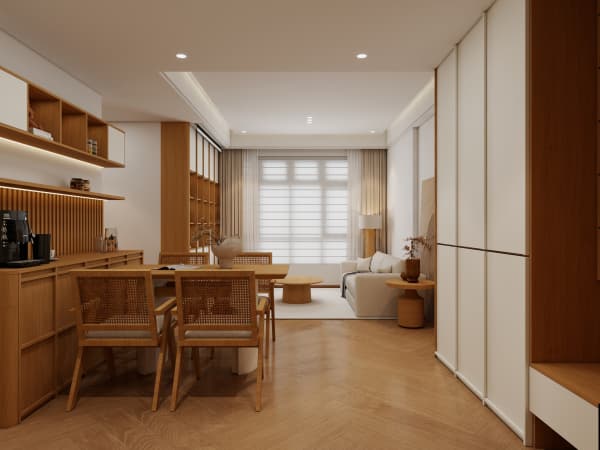
Custom Furniture in the dining room gives you a warm glow without glare when the light is built into the carpentry and bounced off a surface, never pointed at your eyes. The aim is a 2700K wash that makes the room feel lived-in at dinner, not a showroom beam that flattens the food and tires you out.
The bounce method, not the beam
Glare comes from seeing the light source directly. A bare downlight over the table does exactly that, which is why so many dining rooms feel harsh. Instead, hide the strip in a cove along the top of a built-in sideboard or a feature wall, aimed upward so it hits the ceiling and falls back down softened. You see the glow, not the bulb. The same logic works for a recess behind a display shelf: the LED sits in a shadow gap and the wall does the lighting.
Keep the colour temperature low and consistent. Mixing a 3000K cove with a 4000K ceiling light creates a cold patch that the eye reads as dirty. Pick one warm tone across the room and let the carpentry do the accenting.
- Strip hidden in a 15–20 mm cove, aimed at the ceiling
- 2700–3000K, dimmable from the start
- No exposed pucks or downlights aimed at seated eye level
Skip the colour-changing strips entirely. A dining room is not a gaming den, and the rainbow modes read as a teenager's setup rather than a grown home. A single warm white, dimmable, is what makes the glow feel expensive. Pair it with a simple rotary or app dimmer so you can drop to a candle-like 10 percent for late dinners, then back up for cleaning — that range is the difference between a feature you use and a feature you forget. Most homeowners who skip the dimmer end up leaving the cove on full, which defeats the calm entirely.
Wiring it right in an HDB flat
The cove needs a permanent feed, so this is electrician work coordinated with the carpenter, not a battery strip you stick up. In a BTO you flag it during the reno so the wiring runs concealed in the carcass; in a resale you can still tap a nearby power point and hide the driver in the cabinet void. Tell the carpenter the switch location early — a dimmer at the dining room entrance beats a switch behind the sideboard you can never reach.
If your ceiling is the standard 2.6 m, a cove at the top of a 2.1 m sideboard gives a generous wash. Taller ceilings in a condo allow a fuller feature wall, but the rule holds: bounce, don't beam.
Budget for the dimmer in the quote, not as an afterthought. A non-dimmable driver paired with a dimmer switch flickers and eventually fails, so the two must be specified together. The carpenter and electrician should agree on this before the carcass is cut, because the driver size changes the void you leave behind the cove. Get this wrong and you either live with a buzz or pay for a second site visit to swap the part — neither is the relaxing dinner you signed up for.
Custom Furniture for the dining room: glow that lasts
Spec a dimmable driver and a reputable LED strip, because the cheap ones shift colour and flicker within a year. A sideboard cove is a modest add-on, roughly S$400 to S$1,000 on top of the cabinet depending on length and the dimming kit, and it folds into the usual 6 to 10 week carpentry lead time. The joinery carries the standard one-year defect warranty; ask separately how long the LED and driver are covered, since those often run shorter.
Used nightly, the warm wash turns dinner into something calmer than a switched-on ceiling light ever managed. Build the glow into the room and you stop fighting the downlights for good.