Custom Furniture at HDB: A Bench That Opens Flat
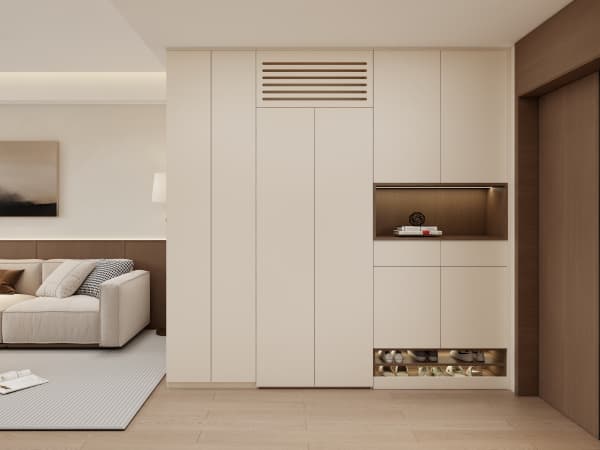
For an HDB flat, Custom Furniture makes the entryway bench that opens flat the most useful piece you can add, spanning the bomb-shelter door or the shoe corner and lifting on a hinge to swallow bags, umbrellas, and the shoe pile. Most 4-room and 5-room flats have a cramped entrance with no cupboard, so a built-in bench works as seat and storage without eating the living room. Fixed to the wall and sized to the exact gap, it becomes part of the renovation rather than crowding it.
Working Around the Bomb Shelter Door
Almost every HDB flat has a bomb shelter, and in many layouts its door sits right at the entrance, a flat steel panel you can't hack, paint, or build over. The bench simply runs up to it and stops, using the dead wall beside the shelter for the seat and the lift-up box. Because the shelter door must always swing fully and stay clear, the carpenter leaves the required clearance and never fixes anything to the door itself. What you gain is a long low storage run where there was bare wall, and a place to sit while lacing shoes that the original flat never offered.
If your shelter is set into a recess, even better: the bench tucks into the recess lips, so it reads as built-in rather than a block in the hallway. Measure the recess depth first; most take a 40 to 45 centimetre seat without protruding into the walking line.
Why Custom Furniture Works Around the Bomb Shelter Door
A store bench is a fixed length and assumes a flat wall; your entrance has the shelter door, the electrical riser, and the shoe area all competing for the same strip. Custom Furniture maps that strip exactly and breaks the storage into the right zones: a deep lift-up box for rarely used bags, a shallow drawer for daily shoes, a cubby for the study keys. You also match the bench top to your flooring or a contrasting timber so the entrance feels designed. Off-the-shelf benches sit at one height and one finish, and they leave the awkward bits of an HDB entrance untouched.
The hinge is the detail that makes it daily-use rather than display. Gas-lift struts hold the lid up while you fish out a rain jacket, then ease it down without trapping fingers, which matters when a child is nearby. Spec soft-close and a stay-open mechanism and the bench gets used for years instead of propped half-open.
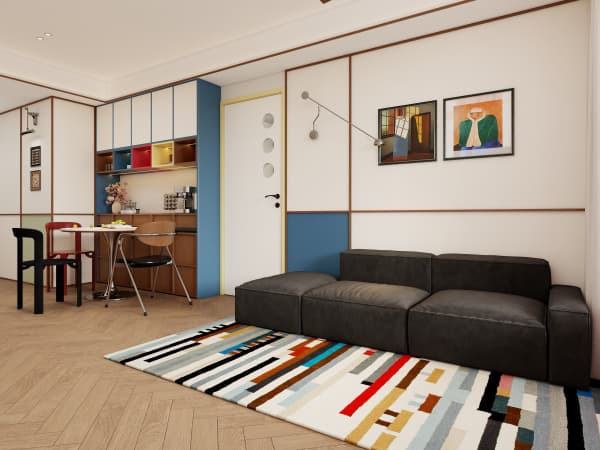
Sizing for a 4-Room Versus a 5-Room Entrance
A 4-room flat is roughly 90 square metres with a tighter entrance, so the bench might be only 1.2 to 1.5 metres of usable wall; make it shallow, 40 centimetres, to keep the doorway clear. A 5-room at about 110 square metres often has more entrance length, letting the bench run 1.8 metres or more and include a back panel with hooks for coats. Either way, keep the seat top at 45 centimetres, a comfortable shoe-lacing height, and leave at least 90 centimetres of clear floor in front so two people can pass when someone is sitting.
Build Details and the Standard Warranty
Fix the bench to the RC wall with proper anchors because a seat people sit on takes sideways load, not just weight. Use a marine-grade or PVC-edged ply for the box if the entrance sees rain from an open door, and a durable laminate on the lid that survives sandy shoes. Most Singapore carpentry comes with a 1-year defect warranty as standard, so note what it covers, typically hinge and joinery faults, and keep the invoice. Lead time for this kind of piece is roughly 6 to 10 weeks, so order it with the rest of the reno rather than after you've moved in and tripped over the shoe pile for the tenth time.
An entryway bench that opens flat is the rare addition that pays back from week one. Shoes stop migrating across the floor, the shelter door stays clear, and there is finally a spot to sit. Build it to the wall, hinge it well, and size it to the flat; the entrance calms down and stays that way.