Custom Furniture by cabinet: A Corner That Turns Smart
Custom Furniture by a corner cabinet can finally make that awkward angle useful, and a few smart touches — sensor light, pull-out trays, a spinning shelf — turn a dead corner into the handiest spot in the room. Corners are where standard cabinets waste the most space, so fixing one pays off fast.
Why corners get wasted
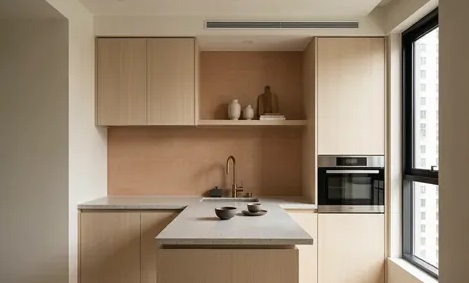
A standard cabinet meets a corner with a blind box you can barely reach. In a 4-room HDB (about 90 sqm) or 5-room (around 110 sqm), that lost wedge adds up across the kitchen and storeroom. A smart corner build reclaims it.
It's not only about space. A lit, easy-open corner just feels better to use. You stop forgetting what's back there because you can actually see and reach it.
Smart touches that earn their keep
We pick the features that match how you cook and store:
Motion sensor light. The corner lights as you approach, so the back isn't a dark void.
Pull-out tray. A tray slides the contents to you instead of you digging in.
Carousel shelf. A spinning tier brings the deep items to the front with a turn.
Soft-close return. The tray eases back so it never slams the corner.
Where the smart corner fits
Kitchens are the obvious spot, but we also build smart corners in the storeroom and the study. Condo owners should check MCST rules before anything near fire-rated walls; internal cabinetry is normally fine.
We measure the exact angle. Not all corners are a true 90 degrees, especially in older flats, and a careless build leaves gaps you can't close.
Custom Furniture that fits the angle
Custom Furniture for a corner must follow the wall, not fight it. We scribe the carcass to the true angle so the doors sit flush and the trays run true. Off-the-shelf corner units rarely do this well, which is why the custom build feels different.
We also match the smart features to the load. Heavy pots want a sturdy carousel; light snacks want a shallow pull-out. Build to the weight, not the look.
Materials that last in a corner
Corner units see more movement than straight runs:
Plywood takes the repeated slide and swing without loosening.
Laminate faces resist the kitchen grease and wipe clean.
MDF is usable for carcasses kept dry, but avoid it near the sink corner.
Solid wood looks rich and lasts, at a higher price and more climate care.
Cost, timeline and approvals
A smart corner cabinet runs roughly S$1,200 to S$3,000 with the mechanism and lighting. Within a full reno of S$30k to S$70k, it's a moderate feature.
From measure to install, allow about 6 to 10 weeks. HDB work carries a one-year defect liability period, so a sticky tray or dead sensor in the first year gets fixed under that cover.
Upkeep and resale
Wipe the sensor lens and check the tray runners every few months. A clogged runner is a quick clean, not a replacement.
At resale, a smart corner reads as thoughtful design, which buyers notice in a kitchen. It shows the renovation was planned, not patched. Keep the finish neutral and it suits any taste.
The plain reason to fix a corner is that it's the space you're already paying for and not using. Light it, pull it out, spin it round, and the dead angle earns its keep. Smart corners are quiet proof that good storage is mostly about the bits others skip.