Custom Furniture for Alcoves: Gaps Turned Into Drawers
Custom Furniture turns the awkward gaps beside your HDB bomb shelter or between stud walls into useful drawers instead of dead air. Most Singapore flats hide a 40 to 80cm void next to the shelter door, and that space is usually just where dust collects.
Find the Gaps Before You Renovate
Walk your flat with a tape measure once the keys are in hand. The common culprits are the recess beside the bomb shelter, the step-in by the service yard, the gap above the door header, and the slice between the kitchen and the living wall. In a 4-room HDB of roughly 90 sqm you can easily recover half a metre of storage width you did not know you had.
These gaps are rarely square, which is exactly why off-the-shelf units fail there. A standard shelf is 35cm deep and 60cm wide; your alcove is 43cm deep and 71cm wide. You either lose the back or leave an ugly slot. Built carpentry follows the wall, not the catalogue.
- Measure the gap at the top, middle, and bottom — HDB walls taper.
- Check for pipes or the electrical riser before you plan drawers.
- Note the floor is often not level; the carcass needs a scribed plinth.
Where Custom Furniture Fits the Alcove
The bomb shelter gap is the classic win. Build a shallow cabinet that runs flush with the shelter door face, fitted with push-open drawers for bills, cables, and the vacuum. Paint the front the same colour as the door and guests will never spot it. Along the kitchen wall, a 25cm-deep spice and oil pull-out uses the dead strip the fridge leaves behind.
For the service yard recess, a floor-to-low cabinet hides the pail and the laundry net, and a flip-up door keeps the cat litter box out of sight. The trick is matching the depth to the item, not forcing a deep box into a shallow gap. Thin drawers for chargers and keys beat one deep cave you have to dig through.
Material Choices for Tight Spaces
In a narrow alcove, plywood with a laminate face is my default. It holds screws at the edges where MDF would crumble, and it survives the humidity near the yard. Solid wood is lovely but it moves with our weather — a teak front on a plywood box gives you the look without the warping risk. Skip glass fronts in the bomb shelter gap; the door bangs and you will regret it within a month.
Soft-close runners are not a luxury here. A drawer in a 50cm gap gets yanked daily, and cheap metal slides drift off their track fast. Spend the few dollars extra on full-extension soft close so the drawer pulls all the way out and closes on its own.
Cost, Timeline, and HDB Rules
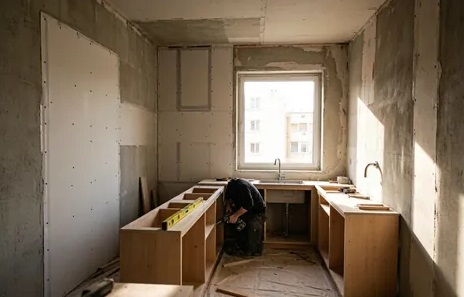
A single alcove cabinet is small, so the price is friendly: roughly S$400 to S$1,200 depending on width and the number of drawers. Because it is minor carpentry, it can ride along with a bigger wardrobe or kitchen order and share the factory slot. From measure to fit, allow roughly 6 to 10 weeks if it is bundled, or a bit less if the workshop has a gap.
HDB rules are light on alcoves since you are not touching structure, but do not box in the electrical meter or the water stopcock. Keep the bomb shelter door clear and swingable — that is a rule HDB checks. Condo owners should flag the work to the MCST if it sits in a common corridor; inside your unit you are free.
Live With It, Not Against It
Label the drawers in your head by use, not by room. The alcove by the door should hold out-the-door things: masks, letters, the umbrella, the dog lead. The kitchen gap holds cooking gear. When each gap has one job, you stop losing the scissors. Wipe the laminate fronts with a damp cloth monthly and the alcove looks new for years.
Done well, the gaps you once ignored become the most-used storage in the flat. That is the quiet promise of whole-house customization — it treats every centimetre of a Singapore home as worth planning, not just the obvious walls.