Custom Furniture in bomb shelter: A Spice Wall That Turns
Custom Furniture in the bomb shelter works best as a turning spice wall, because a made-to-measure rotating rack in the household shelter's dead corner finally puts the condiments you reach for daily within a spin — and since the shelter is the one room every HDB flat has but nobody plans, custom carpentry is how you make it pull its weight without breaking the rules.
How Custom Furniture Fits Inside HDB Bomb Shelter Rules
The household bomb shelter (HBS) is a reinforced concrete box with walls, floor and door you must not hack, drill into structurally, or block. HDB's rule is simple: the shelter has to stay a shelter. That means no cutting the walls, no sealing the door, and no fixing heavy loads to the structure itself. What you can do is stand free-standing or lightly-fixed carpentry inside it — shelves, a wardrobe, a pantry — as long as they sit proud of the wall and the door still swings fully clear. A turning spice wall is exactly that kind of addition: a corner carousel unit that leans or is lightly anchored to the floor, not bolted through the shelter's concrete.
This is why off-the-shelf shelving often fails here. The shelter is a tight, often awkward rectangle with a thick door reveal and a utility pipe run, and factory racks leave gaps you cannot use. Custom work measures the exact corner and turns the wasted angle — the classic dead triangle where two walls meet — into a spinning spice library you reach without crawling in.
Building a spice wall that actually turns
The hero is a corner carousel, sometimes called a lazy Susan for the pantry: two or three tiers on a central post that rotate independently, so the back row of jars comes to the front with a push. Size it to the shelter corner — typically 60 to 80 centimetres per side — and keep each tier 25 to 30 centimetres tall so bottles and packets stand, not lie. The post must be solid (a steel or ply core), because a wobbly spin dumps your paprika across the floor the first time a kid gives it a shove.
Mount the unit so it stands off the shelter wall by a few centimetres; you are not allowed to chase the concrete, and the gap also lets the shelter "breathe" so sealed jars do not sit in trapped damp. A light touch of fixity at the base — a bracket to the shelter floor, not the wall — keeps it from tipping during the rare earthquake drill without touching the structure HDB protects.
- Stand the unit off the wall; never drill the shelter concrete.
- Use a steel or ply core post so the spin stays steady.
- Keep tiers 25–30cm tall so bottles stand and label out.
What belongs in the shelter pantry, and what does not
The shelter is brilliant for dry, non-perishable storage: spices, rice, canned food, the festive ware, the document box. It stays cooler than the rest of the flat, which actually helps dried goods last. What you should not store is anything HDB flags as unsafe — no gas cylinders, no flammable liquids, nothing that turns the shelter into a hazard rather than a refuge. Keep the rotating spice wall to food and small kitchen bits and it is both legal and useful.
One practical layout tip: put the daily spices on the turning wall at the front, and the once-a-year stuff (deep fryer, steamer, spare rice) on fixed shelves behind it. The spin handles frequency; the fixed shelves handle bulk. Together they make the shelter the most efficient square metre in the flat.
Material and the cost of doing it once
Inside the shelter, BWR plywood beats MDF — the room sees less air flow and the odd damp day, and ply will not bulge at the edges. Expect S$90 to S$140 per square foot run, with a corner carousel unit typically S$800 to S$2,000 by scope depending on tiers and the post. The whole shelter fit-out, if you also add fixed pantry shelves, lands around S$3,000 to $6,000. Lead time is the usual six to ten weeks, and because the shelter is small and concrete, measure it with the door open and closed so the unit clears the swing.
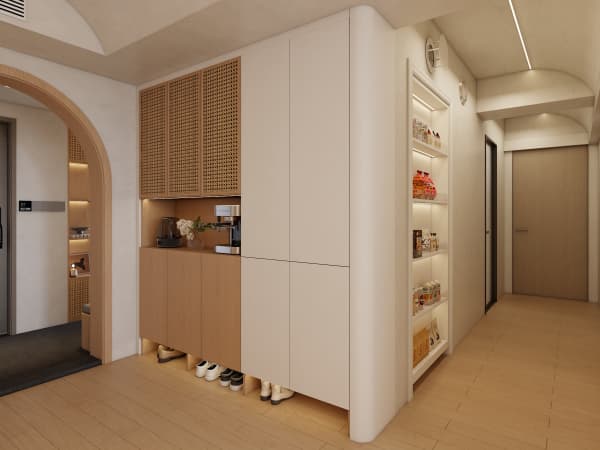
The shelter was never meant to be dead space. Stand a turning spice wall in the corner, keep the door free, and the one room you forgot becomes the one you use every dinner. Measure the angle, spin the jars, and let the shelter finally work.