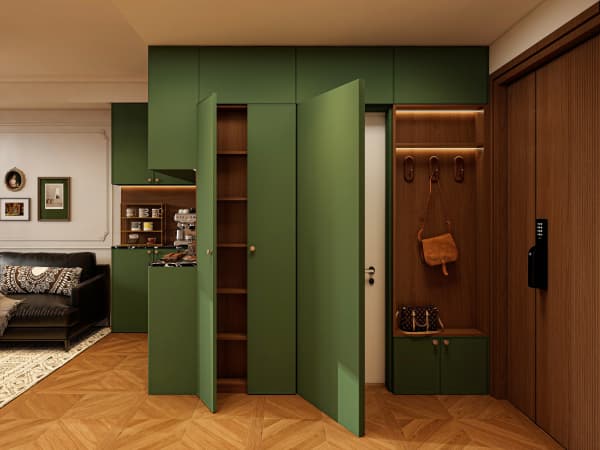
Custom Furniture in corridor: A Hiking Pack Shelf
Custom Furniture in the corridor finally gives the hiking pack a home instead of the floor by the shoe rack where it sheds mud on everyone's path. A dedicated shelf with a hook rail and an open back lets the pack air out after a Bukit Timah climb and keeps the hallway clear for the stroller.
Reading the corridor you actually have
Most HDB corridors are narrow — often 1,000mm to 1,200mm wide from wall to the opposite door — so anything you build must not eat the walking line. A corridor pack shelf should sit flat to the wall at 300mm to 350mm depth, high enough that the pack clears a passing pram but low enough to lift down without a stool. Around 1,500mm to 1,700mm off the floor is the sweet spot for an adult.
Condo corridors are MCST common property, and you generally cannot fix carpentry to the shared wall or leave a shelf protruding into the walkway. Check the by-laws; many condos ban it outright, in which case the pack shelf moves inside your door, on the utility wall just past the entry. HDB corridors are your own airspace, so the build is freer, but still keep the fire escape path clear.
Think about what shares the corridor. If the bomb shelter door is here, the shelf must stop short of the reveal and not block the swing. We measure the open door arc and draw the shelf to end 100mm before it, every time.
Custom Furniture that breathes so the pack dries
A hiking pack comes home wet and salty, and a closed cabinet turns that into mould. Build the shelf open at the back — a slatted base on two brackets, not a box — so air moves through the pack and the mesh dries. Use marine plywood or aluminium for the slats because they will see sweat and the occasional rain-drip from the pack, and skip MDF, which cups within a season.
Add a hook rail below the shelf for the wet rain shell and the trekking poles. Hooks take the poles off the floor where someone trips, and they let the shell hang open to dry. A small tray under the hooks catches the grit that falls out of the soles, and you sweep it weekly.
If the corridor gets no window, add a low-energy LED strip on a sensor so the pack is lit when you come home late from a night hike. Light also discourages the damp corners where the smell starts, and it means you actually see the mud before it walks inside.
Drying gear without smelling out the flat
The pack is only half the problem; the soggy shoes and the damp tee are the other. A corridor shelf with a lower open shoe ledge lets the boots air where the air-con draft from the living reaches, far better than sealing them in the bedroom. Keep the ledge slatted for the same reason, and angle it so water runs to the tray, not the floor.
Ventilation beats deodoriser. A corridor with the entry door open for ten minutes after a hike moves more air than any spray, and an open slat shelf helps that along. If your corridor is sealed and windowless, a small USB fan on the shelf running an hour post-hike keeps the mildew away.
For condo owners who cannot build in the corridor, the same shelf works inside the service yard, where the washer drips anyway and the pack dries faster under the extractor. Just keep it off the MCST fire-rated surfaces and on a freestanding bracket you can move during the annual wash-down.
Give the pack a wall instead of the floor and the whole corridor stays walkable. A hiking shelf is a small, open, breathing build — the kind that pays back the first time you come home muddy and everything has a place to drip.