Custom Furniture of walk-up: A Desk in the Lost Corner
Custom Furniture for a walk-up apartment has to clear the staircase before it clears your taste, and the best desk for a lost corner is one built in sections that a pair of movers can carry up three flights where a single board would never turn the landing. In older walk-ups around Tiong Bahru, Emerald Hill or a low-rise Katong walk-up, the stair is the real specification.
Custom Furniture for a walk-up has to fit the staircase first
Measure the turn, not the room. A typical pre-war walk-up stair lands at about 80 to 90 cm wide with a 180-degree or L turn, and a desk top wider than 70 cm will not make the bend as one piece. The fix is split construction: a top made in two 60 cm halves that bolt together on site, or a frame that flat-packs and the carpenter assembles in the room. Tell the maker the stair width and the tightest turn radius up front, because a beautiful desk that will not climb the stairs is just an expensive doorstop.
This also changes the material. Solid wood splits and rejoins cleanly; a glossy MDF laminate shows the seam unless the joint is scribed and the edge banded on site. For a walk-up, ask for a knockdown detail with hidden bolts and a removable leg, so the next move out is as easy as the move in.
Finding the lost corner under the stair or on the landing
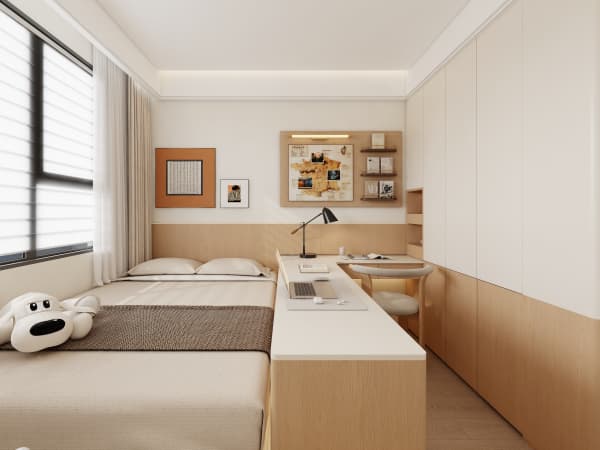
The lost corner in a walk-up is usually the triangle under the stair, the narrow landing, or the slice of wall where the building steps back. A desk there turns dead space into a workstation without eating the living room. Build to the slant: a top that follows the stair soffit, shallow at the low end and full depth where the headroom allows, gives you a 120 to 150 cm run that would never fit as a rectangle.
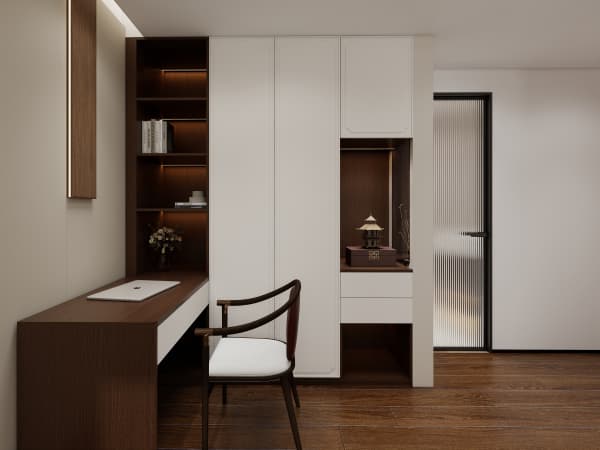
Light is the catch. Corners under stairs are dark, so spec a task light on an arm and a shallow shelf above for the monitor, keeping the deepest part, where you sit, clear of the low beam. In a flat of roughly 70 to 90 sqm the lost corner is often the only quiet spot for a call, so treat it as a real desk, not a folding tray.
Anchoring, wiring and the weight you carry
A walk-up desk still needs to stand solid on an old floor that may not be level. Shim the legs on site rather than trusting the wall, and if you fix to the stair soffit, use the building's own structure, not a partition. Power comes from a nearby point via a short surface trunking; ask the electrician for a floor outlet only if the walk-up already has them, because chasing a concrete stair is not on.
Split a desk this way and the carpentry cost barely moves, roughly S$500 to S$1,000 for a built-in corner piece, but you save the mover's struggle and the heartbreak of a scratched wall. Lead time is the normal 6 to 10 weeks, and a one-year warranty should cover the on-site joints as well as the factory ones, so write that into the quote.
Measure the stair before the moodboard, build in sections, and the lost corner becomes the best desk in the flat. You keep the living room for living, the walk-up keeps its charm, and every move in or out stays a two-person job instead of a crane.