Custom Furniture with wardrobe: A Edge That Won't Chip
The honest answer: Custom Furniture only stays chip-free when the edge banding matches the core board and the hardware is set correctly. Chipping is rarely bad luck. It is 0.4mm PVC tape on a high-traffic door corner, or an MDF edge that met a vacuum cleaner one time too many.
Where edges fail, and why banding decides it
Failures cluster in three places: the vertical leading edge of a swing door at hand height, the bottom corner nearest the walkway where a vacuum head connects, and internal shelf fronts. Thin 0.4mm PVC tape is the default in cheap quotations. It follows the board perfectly, costs almost nothing, and resists impact not at all. One knock lifts it, and once lifted it peels along the glue line. ABS banding at 1mm or 2mm behaves differently: the thicker material can be radiused, so the corner absorbs a knock instead of transmitting it into the board. The cost difference across a full wardrobe is small. Ask for 2mm ABS on every exposed door edge and shelf front, and accept 0.4mm only on hidden internal panels. Solid timber lipping is tougher still and can be sanded if damaged, though a badly fitted one leaves a glue line nothing hides.
Plywood, MDF and solid wood, without the sales talk
Plywood carcasses hold screws, survive being taken apart and refitted, and cope better with a bedroom that runs air-conditioning overnight then sits sealed and humid all day, which makes them the sensible default for the box. MDF gives a dead-flat surface that spray paint loves, which is why every painted shaker front you have admired is MDF, but its weakness is the endgrain: it drinks water, swells irreversibly, and cannot be repaired once it does. Solid wood is the least practical choice for a full wardrobe here, since it moves with humidity and a wide panel will eventually cup. It earns its place as a detail, such as a handle rail or a bench seat.
Planning Custom Furniture wardrobes around real room sizes
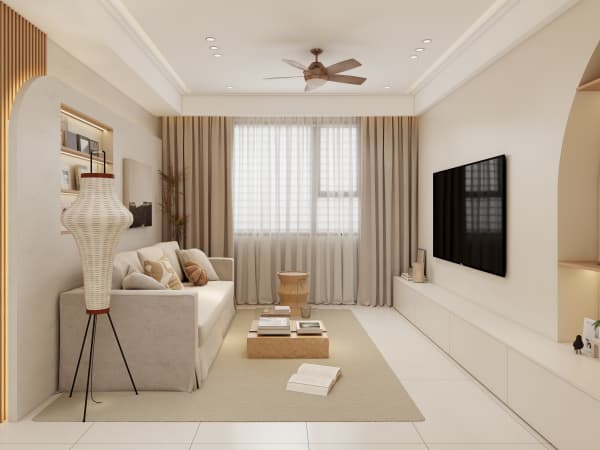
A 4-room flat is roughly 90 sqm and a 5-room roughly 110 sqm, so the master bedroom is generous but the common rooms are not. A common bedroom of 7 to 9 sqm cannot take a 650mm-deep wardrobe on the long wall and still fit a bed with walking space. Practical adjustments:
- Standard hanging depth is 600–650mm. Drop to 550mm and shirts still hang; below 500mm they touch the door.
- Sliding doors save the 600mm swing but permanently block half the opening and cost more in track hardware.
- Build to the ceiling, since the top box swallows luggage and off-season bedding for far less than the floor space you would otherwise lose.
- Leave a 30–50mm scribing allowance, because walls are rarely perfectly plumb.
- Name the hinge and runner brands in the quotation. A cheap hinge drifts within months and the gaps go uneven.
Site conditions, permits and handover day
Do not build against a wall shared with a bathroom unless it has been checked for damp, and keep the base 80–100mm off the floor or on a sealed plinth so an overflowing aircon tray does not wick into the board. In a condominium the MCST will not allow hacking of structural walls and typically restricts noisy works to roughly 9am to 5pm on weekdays. HDB owners need the relevant permit and a contractor listed in HDB's Directory of Renovation Contractors, with noisy work confined to weekdays and not allowed on Sundays or public holidays. BTO owners generally have three to four years between launch and key collection to settle a layout properly. Whole-home carpentry commonly runs S$30,000 to S$70,000 depending on scope, and good hardware is a tiny slice of that.
Carpentry typically takes six to ten weeks from drawings to installation. On the day it goes in, run a finger along every exposed edge before signing and check the door gaps at eye level. A one-year defect warranty is standard, and hinges almost always want one adjustment around month three, which is settling rather than a fault. A lifting edge or a swollen bottom rail is not, so flag those in writing while the cover applies.