HDB Interior Design Singapore: Dining Nook Budget
HDB interior design Singapore projects often start with a simple wish: a proper place to eat without giving up the living room. With a typical 4-room flat measuring about 90 sqm, the dining corner competes with storage, a study desk and the TV feature wall for the same floor area. A recent trend among BTO owners is the banquette nook, a built-in seat against a wall that frees the walking path and hides storage underneath. This article breaks down a realistic budget so you can plan the spend before you meet a contractor.
Why a dining nook makes sense in a compact flat
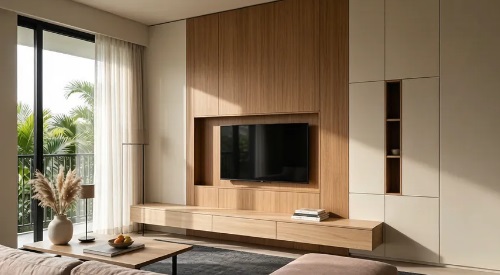
A standalone dining table eats at least 1.2 by 0.8 metres of clear floor. In a 4-room BTO that space is better used for movement. A built-in nook tucks seating into a dead corner, often under a window or beside the kitchen pass. You gain two to three extra seats without a chunky chair footprint. For resale HDB owners the same idea works as a breakfast bay inside an HDB open concept kitchen, where the island doubles as a serving ledge.
The nook also supports HDB flat space saving goals because the base becomes a storage chest for seldom-used trays, linens and seasonal items. Build the base from lightweight plywood carcass with laminate facing, which HDB approves for carpentry. Keep the structure free of structural walls and never box in a window grille required for child safety on higher floors.
Budget breakdown for a basic banquette
A simple L-shaped banquette for a 4-room flat usually lands in the S$1,800 to S$3,200 market range, covering carpentry only. This assumes a 1.8 metre long seat, a 450 millimetre deep base, soft-close hinged tops and a laminate finish matched to your kitchen cabinets. Add S$300 to S$700 for a custom cushion and S$150 to S$400 for a small round table if you skip a fixed top.
- Carpentry base and seat: S$1,800 to S$3,200
- Upholstered cushion: S$300 to S$700
- Table top, round 900mm: S$150 to S$400
- Concealed lighting strip: S$120 to S$300
- Installation and touch up: S$200 to S$450
These are market ranges, not fixed quotes. A resale flat with uneven walls can push carpentry up because the contractor scribes each panel to the true wall line. Tell your HDB renovation permit applicant, the Licensed Renovation Contractor, that the nook is non-structural so it clears quickly during the roughly two week permit window.
Where to spend and where to save
Spend on the hinge hardware. Soft-close stays save the laminate from slam damage and stop the storage from becoming a daily annoyance. Save on the table by reusing a round top you already own or buying a ready made piece instead of a fully bespoke one. Skip the built-in cushion if the nook faces a window you open often, since fixed foam traps heat and smells from cooking.
Choose quartz or solid-surface for any ledge that meets food, because both are HDB approved and wipe clean. Vinyl or laminate flooring underneath is fine and cheaper than tiles. If the nook sits on a balcony of a newer BTO, remember HDB does not allow the balcony to be enclosed, so keep the seating low and removable.
Step by step to lock your budget
- Measure the corner from skirting to ceiling and note the window height.
- Decide seat length so the walkway keeps at least 900mm clearance.
- Pick laminate colour and a cushion fabric you can wash.
- Ask the contractor for a line-item quote, not a lump sum.
- Confirm the build is non-structural and list it on the permit form.
- Schedule noisy carpentry delivery on a weekday 9am to 6pm slot.
- Hold 10 percent of the budget back until the soft-close works smoothly.
A dining nook is one of the cheapest ways to make a compact home feel considered. If you want the seating, storage and lighting to read as one whole-house customization rather than an afterthought, bring the nook plan to a designer during the BTO renovation timeline so the carpentry lines up with your kitchen and feature wall from day one.